
Smoke Control Engineering – Part 1 of 4
Smoke control in large-volume spaces is one of the most technically demanding areas of Fire Safety Engineering. Atria, airports, shopping centres, railway stations, exhibition halls, warehouses and large industrial buildings do not behave like conventional compartmented spaces during a fire. Their geometry, vertical development and open connections between levels significantly influence smoke movement, plume development and the formation of the upper smoke layer, making simple extensions of conventional room-based design approaches potentially misleading.
In these buildings, it is not sufficient to ask how much smoke is produced by the fire itself. A proper engineering assessment must consider how the fire plume develops, how much surrounding air is entrained during the upward movement, how quickly the smoke layer forms and descends, and what mass or volumetric flow rate must ultimately be removed to maintain the required conditions within the occupied zone.
This is the starting point of this four-part series dedicated to Smoke Control Engineering in large-volume spaces.
Before discussing fans, duct systems, natural smoke vents or control strategies, it is necessary to understand the physical behaviour of smoke, because the performance of any smoke control system is determined by the phenomenon that the system is required to manage. In other words, smoke control design should not begin with the selection of equipment; it should begin with a clear understanding of how smoke is produced, transported and accumulated within the building.
Smoke Control in Large-Volume Spaces – Article Series
- Smoke Control in Large-Volume Spaces: Why an Atrium Is Not Simply a Larger Room – this article
- The First Minutes of a Fire: How Quickly Can Smoke Fill a Large Space?
- How Much Smoke Must We Really Exhaust? From Fire Plume to Smoke Control Flow Rate
- Natural or Mechanical Smoke Exhaust? How to Choose the Right Strategy
The sequence is deliberately progressive and follows the logic of the physical problem:
phenomenon → time → flow rate → smoke control strategy
In This Article
How Does Smoke Behave in Large-Volume Spaces?
What Is Smoke During a Fire?
Fire Plume and Entrainment: Why Smoke Flow Increases with Height
How Much Smoke Can a 5 MW Fire Produce?
How Do We Calculate the Volumetric Smoke Flow Rate?
Why Does Atrium Height Have Such a Strong Effect on Smoke Production?
Why Is Smoke Dangerous Even Before It Becomes Toxic?
What Is a Smoke Layer?
Why Does the Smoke Layer Continue to Descend?
Which Parameters Define the Smoke Hazard?
Why Does Atrium Geometry Affect Smoke Control?
What Is the Real Objective of a Smoke Control System?
Are Sprinklers and Smoke Control Independent Systems?
How Can We Predict Smoke Behaviour?
How Quickly Can Smoke Fill a Large Space?
The Fundamental Principle of Smoke Control Engineering
Frequently Asked Questions
Conclusion
How Does Smoke Behave in Large-Volume Spaces?
To understand why large-volume spaces require a specific engineering approach, it is useful to compare two identical fires developing in two very different environments.
In the first scenario, the fire develops inside a relatively small room with conventional floor-to-ceiling dimensions. In the second, the same fire develops at floor level inside an atrium twenty or thirty metres high. The heat release rate may be identical, the fuel package may be identical and the combustion process may initially be very similar, but the behaviour of the smoke will differ substantially, because the surrounding geometry changes the way the fire plume develops.
In a conventional compartment, the walls and ceiling rapidly limit the volume into which combustion products can spread, whereas in a large atrium the plume can rise for many metres before reaching the roof. During that vertical travel, the plume progressively increases in diameter and continuously incorporates surrounding air; after reaching the upper part of the space, the gases spread horizontally and begin to accumulate beneath the roof, eventually forming an upper smoke layer.
If the atrium is connected to several floors, balconies, corridors or adjacent spaces, smoke movement becomes even more complex, because the plume and the upper layer can interact with openings, overhangs, galleries and communicating volumes. For this reason, smoke control in large-volume buildings cannot be reduced to a simple question of building volume or air changes per hour.
At first sight, a high ceiling may appear to provide an obvious safety advantage: smoke can accumulate in the upper part of the space while the occupied zone remains relatively clear. That advantage is real, but it is only one side of the problem, because the same height that provides additional storage volume for smoke also allows the plume to develop over a much greater vertical distance.
This introduces one of the most important concepts in the entire smoke control problem: air entrainment.
What Is Smoke During a Fire?
In everyday language, smoke is often understood simply as the visible products released by burning materials. From an engineering point of view, this definition is incomplete, because the gas flow that ultimately reaches the upper part of a large space is not composed only of combustion products.
Smoke includes particles, gases and products generated by combustion and pyrolysis, but the fire plume also entrains large quantities of ambient air as it rises. This entrained air becomes part of the total gas flow and, in many large-volume applications, represents a substantial proportion of the mass that the smoke control system must ultimately manage.
When a fire develops at floor level, the combustion gases are heated and become less dense than the surrounding air. The resulting buoyancy force causes the hot gases to rise and generates the fire plume. The plume, however, does not behave as an isolated vertical column: as it rises, it continuously draws ambient air from the surrounding space, so its mass flow rate increases with height. This process is known as entrainment.
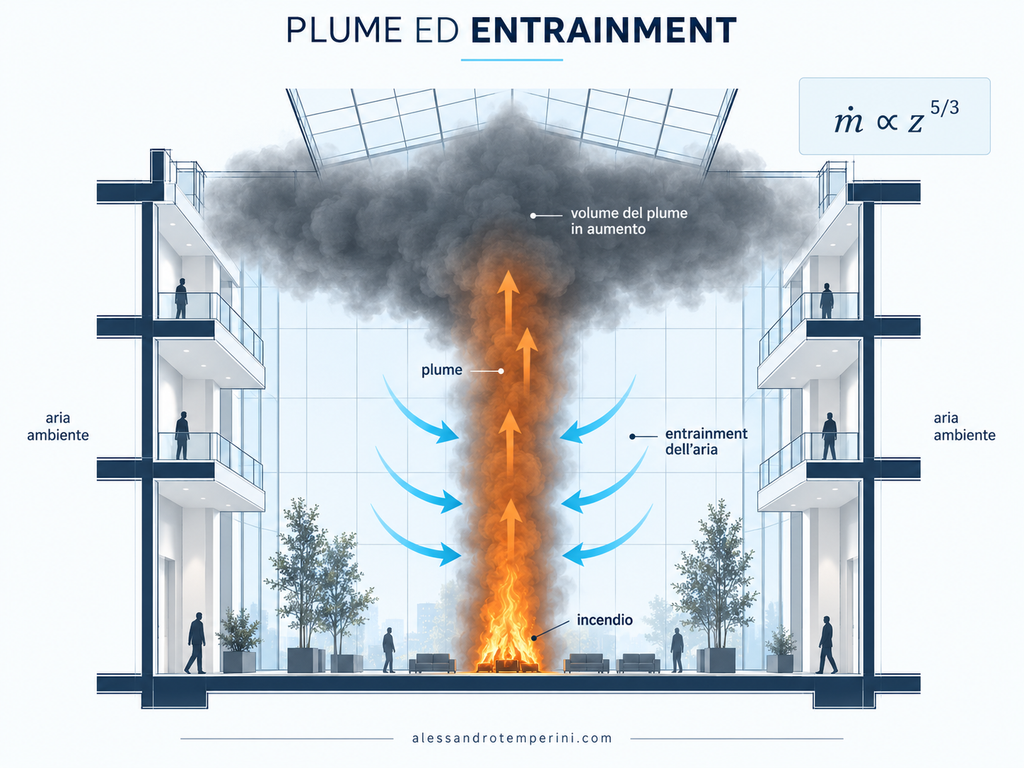
The higher the plume rises, the more air is incorporated into it, and this produces two effects that must be considered together:
the total mass flow increases;
the combustion products become progressively diluted and the average plume temperature decreases, because the entrained air is cooler than the gases close to the fire source.
This apparently simple mechanism is fundamental to smoke control design, because it explains why the amount of gas reaching the upper part of an atrium can be much greater than the quantity of combustion products directly generated by the fire.
The smoke flow that must be managed by the system is not simply the amount of material produced by combustion; it is the total plume flow after entrainment has occurred.
Fire Plume and Entrainment: Why Smoke Flow Increases with Height
Entrainment can be described quantitatively using empirical correlations derived from experimental observations of fire plumes.
For an axisymmetric plume – a plume developing sufficiently far from walls or other vertical boundaries – a commonly used correlation for the plume mass flow rate is:
ṁ = 0.071 · Q̇c1/3 · z5/3 + 0.0018 · Q̇c
where:
ṁ = plume mass flow rate [kg/s]
Q̇c = convective heat release rate [kW]
z = vertical distance between the fire source and the smoke layer [m]
Before using this relationship numerically, it is worth examining its structure, because the exponents already reveal the sensitivity of the phenomenon. The convective heat release rate appears as Q̇c1/3, while the vertical distance appears as z5/3. The influence of height on plume mass flow is therefore particularly significant and, importantly, non-linear:
ṁ ∝ z5/3
Increasing the distance between the fire source and the smoke layer does not produce a proportional increase in plume mass flow; the effect becomes progressively stronger, because the plume has more distance over which to entrain surrounding air.
This is one of the reasons why smoke control in very tall spaces can require extremely large exhaust capacities, even when the design fire itself is not exceptionally large.
How Much Smoke Can a 5 MW Fire Produce?
A numerical example helps translate the previous concept into more intuitive engineering terms.
Consider a fire with a total heat release rate of:
Q̇ = 5,000 kW = 5 MW
Not all of the energy released by the fire contributes directly to the convective plume, because part of it is transferred by radiation. Assuming a convective fraction of approximately 0.7:
Q̇c = 0.7 × 5,000 = 3,500 kW
Now assume that the vertical distance between the fire source and the smoke layer interface is:
z = 20 m
Applying the plume correlation:
ṁ = 0.071 × 3,5001/3 × 205/3 + 0.0018 × 3,500
ṁ ≈ 165 kg/s
The physical interpretation of this value is more important than the number itself.
A 5 MW fire is not directly producing 165 kg/s of combustion products. The value represents the total mass flow within the plume at the selected height, including the large quantity of ambient air entrained during the upward movement.
This distinction is fundamental, because the smoke control system must manage the total plume flow reaching the upper smoke layer, not simply the mass of the products generated by combustion. The engineering problem is not merely the removal of combustion products; it is the management of the complete buoyant plume after entrainment has significantly increased its mass.
How Do We Calculate the Volumetric Smoke Flow Rate?
Fans and duct systems are normally specified in terms of volumetric flow rather than mass flow, so the next step is to convert the plume mass flow rate into a volumetric value:
V̇ = ṁ / ρ
where:
V̇ = volumetric flow rate [m³/s]
ṁ = mass flow rate [kg/s]
ρ = smoke density [kg/m³]
If, purely for this first simplified example, a density of ρ = 1.2 kg/m³ is assumed:
V̇ = 165 / 1.2 ≈ 138 m³/s
Converting into cubic metres per hour:
138 × 3,600 ≈ 497,000 m³/h ≈ 500,000 m³/h
Parameter Symbol Value
Total heat release rate Q̇ 5,000 kW
Convective heat release rate (χc = 0.7) Q̇c 3,500 kW
Fire source to smoke layer distance z 20 m
Plume mass flow rate ṁ ≈ 165 kg/s
Volumetric flow rate (ρ = 1.2 kg/m³) V̇ ≈ 138 m³/s ≈ 500,000 m³/h
This figure immediately shows the scale of the phenomenon. A fire of only a few megawatts, located within a sufficiently tall space, can generate plume flow rates corresponding to several hundred thousand cubic metres per hour, because the majority of the transported mass is entrained ambient air.
However, this value must not be interpreted as an automatic fan selection. The actual smoke density depends on temperature; the plume configuration depends on the location of the fire; wall and corner effects can reduce entrainment; balcony geometry can generate a spill plume; and exhaust points can become ineffective if plugholing occurs. In addition, the behaviour of the system depends strongly on the way make-up air is introduced into the lower part of the space.
These aspects will be developed in the following articles, but the example already makes one point very clear:
Large-volume smoke control is fundamentally a plume management problem, not simply a room ventilation problem.
Why Does Atrium Height Have Such a Strong Effect on Smoke Production?
The influence of height can be examined directly from the simplified relationship ṁ ∝ z5/3. Suppose, as a purely theoretical sensitivity exercise, that the available plume development height is doubled (z2 = 2 · z1). The ratio between the two mass flow rates becomes:
ṁ2 / ṁ1 = (z2 / z1)5/3 = 25/3 ≈ 3.17
Within the assumptions of the correlation, doubling the plume development height can increase the associated plume mass flow by more than three times.
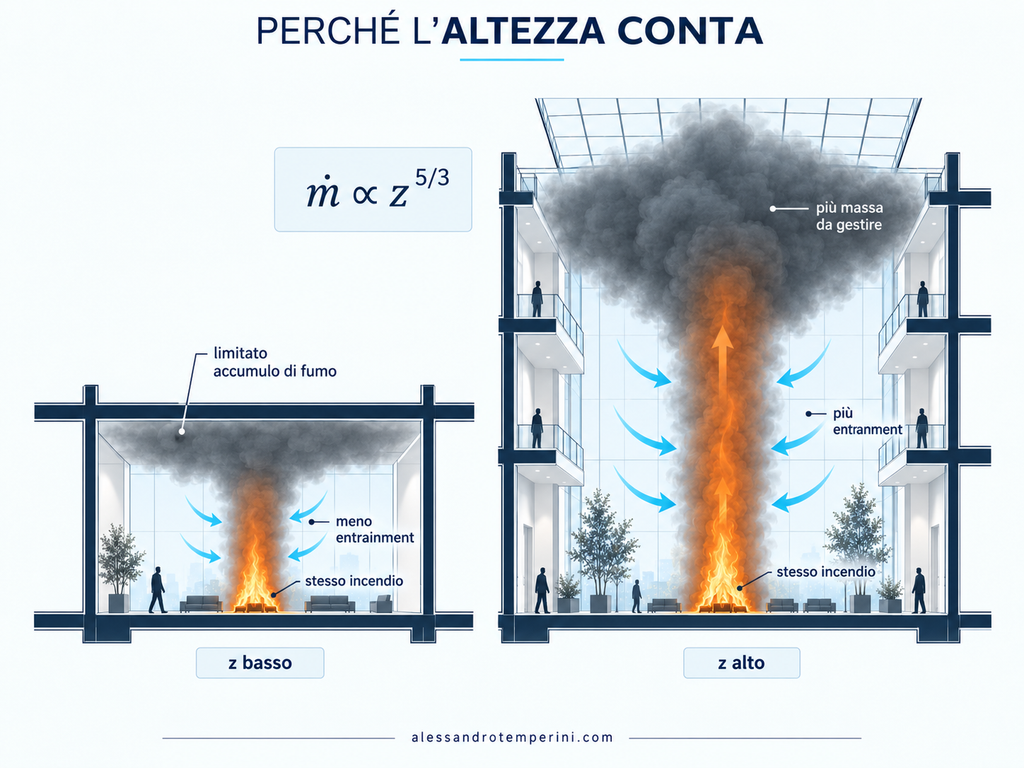
This does not mean that two real buildings should be compared by varying only one parameter, because actual smoke behaviour depends on geometry, fire growth, boundaries and many other conditions. Nevertheless, the comparison illustrates how strongly the entrainment process is affected by vertical distance.
This creates an important design paradox. A taller atrium provides more volume for smoke accumulation and may delay the impact of the smoke layer on occupants; at the same time, the increased height allows the plume to entrain a much larger quantity of air, delivering a substantially greater mass flow to the upper smoke layer.
For this reason, height should be considered simultaneously as an available smoke reservoir and as a critical variable affecting smoke production.
Why Is Smoke Dangerous Even Before It Becomes Toxic?
Smoke hazard is sometimes discussed almost exclusively in terms of toxic gas concentration, but this approach is incomplete, because smoke can compromise life safety in several ways before directly toxic conditions are reached.
Smoke affects visibility, orientation, walking speed, recognition of escape routes and the ability to identify obstacles. It can expose occupants and firefighters to elevated temperatures and toxic species, and smoke contamination may damage equipment, building services and sensitive contents even when direct fire damage remains limited.
How Important Is Visibility During a Fire?
Consider a person moving through a building that is completely familiar under normal conditions. When visibility is good, doors, stairs, signs and obstacles are identified quickly and movement is efficient. When the smoke layer descends and visibility decreases, the geometry of the building remains unchanged, but the occupant’s ability to navigate through it deteriorates significantly.
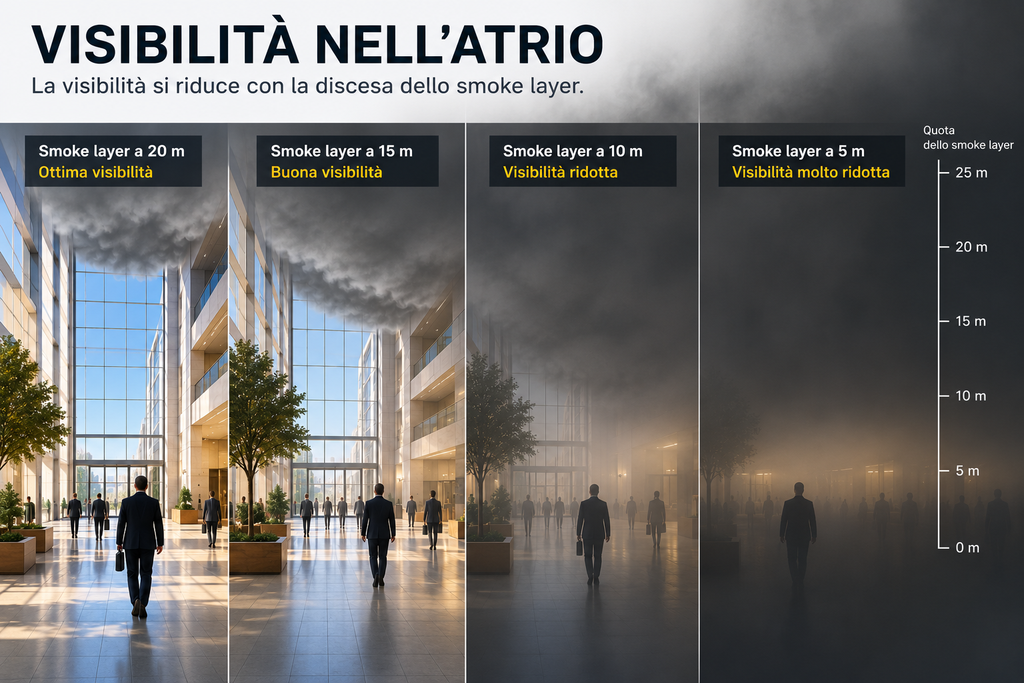
Reduced visibility makes escape routes difficult to identify, increases hesitation, reduces walking speed and makes obstacles harder to detect. Evacuation takes longer, and exposure time to heat and toxic combustion products may increase.
Visibility should therefore be considered a safety parameter, not merely a qualitative indication of smoke density. The relevant question is not only whether toxic concentrations have been reached, but also whether occupants can still identify the route to safety and move through the space efficiently. This is why maintaining a sufficiently clear lower layer is frequently one of the primary objectives in smoke control design.
Smoke Temperature and Gas Concentrations
Smoke also transports energy, and elevated temperatures can directly affect occupants, firefighters, building components and sensitive equipment. In large-volume spaces, however, the large quantity of ambient air entrained into the plume can significantly reduce the average smoke temperature before it reaches the upper part of the building.
This cooling effect does not eliminate the hazard; rather, it demonstrates why temperature, visibility and gas concentration must be treated as separate parameters. Combustion gases may include carbon monoxide, carbon dioxide and hydrogen cyanide, and their concentrations depend on both the fuel involved and the combustion conditions.
A complete smoke control assessment should not simply ask how much smoke is present. It should consider where the smoke is located, what temperature it has reached, how strongly it reduces visibility and what concentrations of relevant combustion species are present.
What Is a Smoke Layer?
Once the rising plume reaches the roof or ceiling, the vertical flow cannot continue in the same direction, and the hot gases begin to spread horizontally beneath the upper boundary of the space. As more smoke reaches this region, an upper layer progressively develops, while the lower part of the atrium may remain relatively clear.
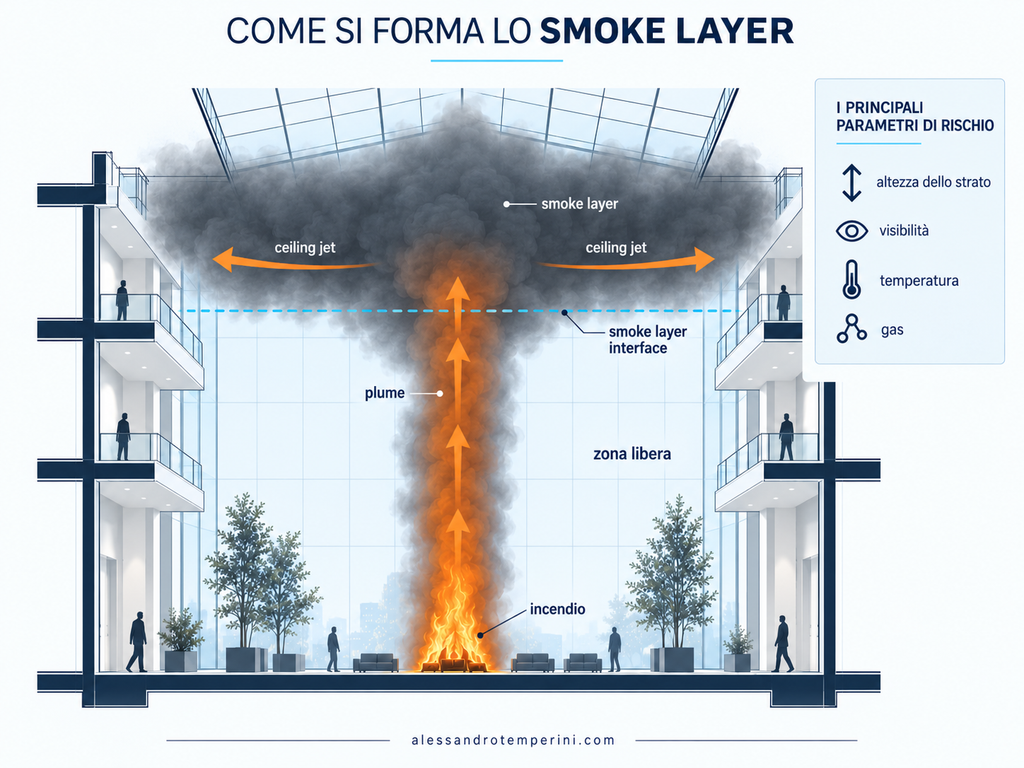
This upper region is known as the smoke layer, and its idealised lower boundary is referred to as the smoke layer interface.
In reality, the transition between the upper smoke layer and the lower clear zone is not perfectly sharp, because mixing occurs across an interface region. Nevertheless, the two-layer representation is extremely useful, because it allows the smoke environment to be described with a simple and intuitive design parameter: the height of the lower boundary of the smoke layer.
If the smoke layer remains sufficiently high, a relatively clear volume can be maintained below it, supporting evacuation and firefighting operations. As the layer deepens and the interface moves downward, the available clear space becomes progressively smaller. The smoke layer interface height therefore becomes one of the most important variables in the analysis of atria and other large-volume spaces.
Why Does the Smoke Layer Continue to Descend?
The behaviour of the smoke layer can be understood through a basic conservation-of-mass relationship. Before the exhaust system begins to remove mass from the upper layer, the plume continuously transfers additional gas into that region:
dmu/dt = ṁp
where:
mu = mass contained within the upper smoke layer
ṁp = mass flow rate supplied by the plume
As long as smoke continues to enter the layer and no mass is removed, the mass in the upper region must increase: the smoke layer becomes deeper and the interface moves progressively downward.
When the exhaust system is operating, the balance becomes:
dmu/dt = ṁp − ṁe
where ṁe is the exhaust mass flow rate.
If ṁe < ṁp, the plume continues to supply more mass than the system can remove, and the smoke layer continues to deepen.
If ṁe ≈ ṁp, the smoke layer may reach an approximate equilibrium and the downward movement of the interface can be arrested.
This simplified balance expresses one of the fundamental principles of Smoke Control Engineering:
The required exhaust capacity cannot be defined until the plume flow reaching the smoke layer has been understood.
Which Parameters Define the Smoke Hazard?
A smoke control system cannot be evaluated on the basis of exhaust flow rate alone, because several physical parameters contribute simultaneously to the overall hazard. Four variables are particularly important:
smoke layer interface height;
temperature;
visibility or optical obscuration;
gas species concentration.
A design question such as “How many cubic metres per hour can the system exhaust?” is relevant, but incomplete. A more appropriate engineering question is:
What environmental conditions can the system maintain within the building during the selected design fire scenario?
This distinction is fundamental, because it shifts the design from a component-based approach to a performance-based approach.
Why Does Atrium Geometry Affect Smoke Control?
Smoke movement is strongly influenced by building geometry, so the design of a smoke control system should begin not with the equipment, but with a clear understanding of the space in which the system will operate.
An atrium can be narrow and very tall, wide and relatively low, or characterised by multiple galleries, balconies and communicating openings. A shopping centre may include several units discharging smoke into a central mall, while an airport terminal or exhibition hall may contain large open areas with highly irregular roof geometry.
Two buildings can have a similar total volume while producing very different smoke behaviour, because geometry determines:
the plume development distance;
the horizontal spread beneath the roof;
the interaction with walls and balconies;
the path by which smoke can reach adjacent spaces.
The physics of buoyant flow remains the same, but the way those mechanisms develop within the building depends on its geometry. This is why smoke control should never be designed purely on the basis of total building volume.
What Is the Real Objective of a Smoke Control System?
A smoke control system should begin with a clearly defined performance objective rather than the selection of a specific piece of equipment. The design team must first determine what condition needs to be maintained during the fire scenario. The objective may be to:
maintain a specified clear height below the smoke layer;
prevent smoke migration into adjacent spaces;
preserve acceptable visibility;
limit smoke accumulation in upper regions;
support firefighter access.
Once the objective has been established, the appropriate smoke management strategy can be selected: limiting the size of the fire, using physical barriers, applying mechanical smoke exhaust, using natural smoke ventilation or controlling airflow between spaces.
In practice, these measures are often combined rather than applied independently, and their interaction can be as important as the performance of each individual system.
Are Sprinklers and Smoke Control Independent Systems?
Sprinkler systems and smoke control systems should not always be treated as completely independent, because the operation of one system can alter the physical conditions affecting the other.
When sprinklers control fire growth, the heat release rate may decrease, which can reduce plume mass flow and smoke production. At the same time, water droplets can cool the smoke and reduce its buoyancy.
This second effect becomes particularly important when natural smoke ventilation is used, because the driving force for natural ventilation depends directly on the density difference between hot smoke and the surrounding air. Sprinklers can therefore simultaneously reduce the fire and modify the buoyant behaviour of the smoke.
This is a clear example of why Fire Safety Engineering should consider the building as an integrated system rather than as a collection of independent fire protection components. The interaction between sprinklers and smoke control will be examined in more detail in the fourth article of this series.
How Can We Predict Smoke Behaviour?
Once the physical scenario and the design objectives have been defined, an analytical or numerical method is required to predict how smoke will develop over time. Several levels of modelling are available:
algebraic correlations;
zone models and computer-based zone models;
field models and Computational Fluid Dynamics (CFD);
physical scale models.
These tools should not be ranked simply from “simple” to “advanced”, because the most sophisticated model is not automatically the most appropriate. The correct model is the one that adequately represents the physical phenomena relevant to the specific engineering question.
Zone Model or CFD: Which Should We Use?
A zone model represents the large space using a limited number of relatively homogeneous control volumes, typically an upper smoke layer and a lower clear zone. This approach simplifies the real flow field, but can provide very useful predictions of smoke layer height, layer temperature and smoke filling time.
There are, however, situations in which the assumption of relatively uniform layer properties becomes less representative. In a very large atrium, conditions may vary significantly from one area to another; sprinkler activation can create substantial mixing between the upper and lower zones; and a plume may lose buoyancy before reaching the ceiling because the upper part of the atrium is already warmer than the air below.
When local flow structures become important, more detailed methods such as field models or CFD may be necessary. CFD can provide local distributions of temperature, velocity, smoke concentration and pressure, but this additional detail does not remove the need to define the scenario correctly. A highly sophisticated model based on incorrect or unrealistic assumptions may still produce misleading results.
One of the most important skills in Fire Safety Engineering is therefore not simply the ability to perform complex calculations, but the ability to select a modelling approach appropriate to the physics of the problem.
Can We Calculate the Smoke Layer Height Over Time?
For certain geometries and within defined ranges of applicability, empirical correlations can be used to estimate the evolution of the smoke layer interface. For a steady fire, one such correlation is:
z / H = 1.11 − 0.28 · ln [ (t · Q̇1/3 · H−4/3) / (A / H2) ]
where:
z = smoke layer interface height [m]
H = total height of the space [m]
t = time [s]
Q̇ = fire heat release rate [kW]
A = horizontal cross-sectional area [m²]
The correlation is based on experimental data and should only be used within its range of applicability (shape factor A/H² between approximately 0.9 and 14, and z/H ≥ 0.2). Its structure is nonetheless informative: smoke layer development depends simultaneously on fire size, time and building geometry.
There is therefore no universal answer to the question “How long does it take an atrium to fill with smoke?” The answer depends on the relationship between fire growth and the geometry of the space.
How Quickly Can Smoke Fill a Large Space?
Up to this point, the discussion has focused mainly on the spatial development of the plume and the smoke layer, but the same process must also be considered in time.
A smoke control system does not become fully effective at the instant of ignition. The plume must develop, smoke must travel through the space, the detection system must respond, the control logic must operate, fans or vents must activate and the system must reach its required operating condition. During this entire period, the fire may continue to grow.
In large-volume spaces, an additional phenomenon known as transport lag becomes important. It includes the time required for the plume to travel from the fire source to the ceiling and the subsequent time required for the ceiling jet to spread horizontally beneath the roof. These two components are generally referred to as:
plume transport lag;
ceiling jet transport lag.
This delay can initially create the impression that smoke accumulation is occurring slowly, particularly in a very tall atrium. Once the smoke layer is established, however, its interface can descend rapidly.
An Example: Four Metres of Smoke Layer Descent in Twenty Seconds
Consider an atrium with a cross-sectional area A = 800 m² and a height H = 20 m (shape factor A/H² = 2.0), subjected to a fast t² fire (growth time tg = 150 s). Using the corresponding empirical correlation for t² fires:
Time from ignition Smoke layer interface height z Comment
120 s ≈ 19 m The interface is still very close to the roof
140 s ≈ 15 m The interface has descended 4 m in 20 s
After two minutes, the lower boundary of the smoke layer is still very close to the roof, which might suggest that a large clear volume is still available. Yet only 20 seconds later (140 − 120 = 20 s) the interface has descended by 4 metres (19 − 15 = 4 m).
This example demonstrates that the early stages of smoke development can be misleading. A large atrium may appear to provide a significant safety margin, but part of that apparent margin may simply be the transport time required for the plume and ceiling jet to establish the smoke layer. Once that phase is complete, the smoke layer can descend much more rapidly.
For this reason, smoke control design must consider not only the steady-state exhaust capacity, but also the time required for that capacity to become available.
The Fundamental Principle of Smoke Control Engineering
The analysis developed so far allows us to return to the central design question. Designing a smoke control system does not simply mean selecting equipment capable of extracting a certain air volume. The real objective is to control the evolution of a physical phenomenon so that specified environmental conditions can be maintained within the building for the required period of time.
Fans, ducts, natural vents and smoke barriers are all tools used to achieve that objective, but none of them defines the objective itself. The design must first establish:
which fire scenario is being considered;
how the plume is expected to develop;
how much mass will reach the smoke layer;
what clear height must be maintained;
for how long that condition must remain acceptable.
This, in my view, is one of the fundamental differences between simply sizing a system and applying Fire Safety Engineering.
A very large fan may have an impressive nominal capacity, but if the plume flow has been incorrectly estimated, if make-up air is poorly introduced, if the smoke layer descends before the system reaches its design flow, or if the selected model does not represent the actual building geometry, the nominal fan rating alone provides little information about the real performance of the smoke control strategy.
In the Next Article: The First Minutes of a Fire
This first part of the series has established the physical basis needed for the following articles. We have seen that smoke consists not only of combustion products but also of substantial quantities of entrained air, and we have examined why tall spaces can produce very large plume mass flow rates even for fires with moderate heat release rates.
We have also introduced the smoke layer and shown that, in simplified terms, its stability depends on the balance between the mass supplied by the plume and the mass removed by the exhaust system:
ṁe ≈ ṁp
The next step is to introduce time. The second article will examine plume transport lag, ceiling jet transport lag, t² fire growth and the time required for the smoke layer to reach a critical height.
The key comparison will be between two timelines: the time required for the fire to create critical conditions within the building, and the time required for the smoke control system to detect the event, activate and reach its required performance. Because a smoke control system may be correctly sized in steady-state terms and still become effective too late.
Frequently Asked Questions
What is smoke control?
Smoke control is the combination of strategies used to limit smoke movement and accumulation during a fire, with the objective of maintaining specified environmental conditions within the building. Depending on the application, it may include mechanical exhaust, natural smoke ventilation, smoke barriers, compartmentation or controlled airflow between spaces.
Why does smoke behave differently in an atrium?
A large vertical distance allows the fire plume to entrain substantial quantities of ambient air while rising. As a result, the total mass and volume of gas reaching the upper smoke layer can become much larger than the amount of combustion products generated directly by the fire.
What is a smoke layer?
The smoke layer is the upper region of hot and contaminated gases that develops beneath the roof or ceiling. The position of its lower interface is one of the key parameters used to evaluate whether a sufficiently clear lower zone can be maintained.
Does smoke exhaust flow depend only on fire size?
No. Smoke exhaust requirements are influenced by fire size, plume configuration, vertical distance to the smoke layer, position of the fire relative to walls or corners, building geometry and the target smoke layer height.
Why is atrium height important in smoke control design?
Atrium height has a dual effect. It provides additional volume in which smoke can accumulate before reaching the occupied zone, but it also allows the plume to entrain more ambient air during its rise, increasing the mass flow that may need to be exhausted.
Conclusion
Smoke control in large-volume spaces begins with a relatively simple principle: a system cannot be designed correctly unless the physical behaviour of the smoke is understood first.
Smoke is not merely contaminated air that must be removed from the building. It is a dynamic gas flow created by combustion products and by the large quantity of ambient air entrained into the fire plume during its rise. Its mass changes with height, its temperature changes with entrainment, its visibility effects influence evacuation and its accumulation determines the position of the smoke layer interface.
The plume interacts with the building geometry, with barriers, with ventilation systems and with other fire protection measures, and all of these interactions evolve continuously over time.
For this reason, before selecting fans, smoke vents, duct sizes or exhaust capacities, a more fundamental question must be answered:
What smoke behaviour are we trying to control, under which fire scenario, and for how long?
Only after defining these conditions can smoke control design move from a simple equipment-sizing exercise to a proper Fire Safety Engineering process.
In the next article, we will introduce the variable that determines whether all of these calculations remain useful in a real fire: time.
About the Author
Alessandro Temperini – Engineer and professional working in Fire Safety Engineering and smoke and heat control systems. In this series, I explore the physical and engineering principles behind Smoke Control Engineering, connecting technical literature, engineering calculations and practical experience.
